Comparison of USPTO and PCT e-filing systems
Those who have e-filed US patent applications are familiar with the PASAT/XPort/ePave process. For most US filers, authoring is done with PASAT, which is basically Microsoft Word together with a plug-in for XML authoring.
After an XML specification is prepared (using PASAT), it is necessary to use a conversion utility called XPort. This utility converts the PASAT output (which complies with an older XML document type definition) into XML code which complies with the Annex-F document type definition.
The Annex-F XML file created by XPort is then given to ePave, which packages the submission and transmits it to the US Patent Office's ePave server.
At the present time the USPTO is beta-testing a new XML authoring tool called EFS-ABX. EFS-ABX is a Microsoft Word template that works with Microsoft Word. EFS-ABX permits authoring a patent specification as a more-or-less standard Microsoft Word file. The user can export the Microsoft Word file in the form of XML. The XML file is given to ePave which packages the submission and transmits it to the USPTO's ePave server.
PCT-SAFE. The World Intellectual Property Organization (WIPO) is conducting a pilot program in which a small number of filers are filing PCT applications electronically. After the PCT e-filing software (called PCT-SAFE) is tested and debugged, it will be released for use by all PCT filers. WIPO has suggested that this may be released by about January of 2004.
The PCT e-filing system begins with the PCT-SAFE Editor (PSE). This editor is basically a commercial XML editor (XMetal from Corel) together with some customizations for use with patent applications. The design of PSE is thus quite different from that of PASAT, or EFS-ABX -- PASAT starts with a word processor and adds a plug-in to make possible XML editing, while PSE starts with an XML editor to which code has been added for patent applications.
User preferences may prompt some users to prefer one editor or another. For example, users who have previously done HTML editing may find themselves more comfortable with the user interface of the PCT-SAFE editor.
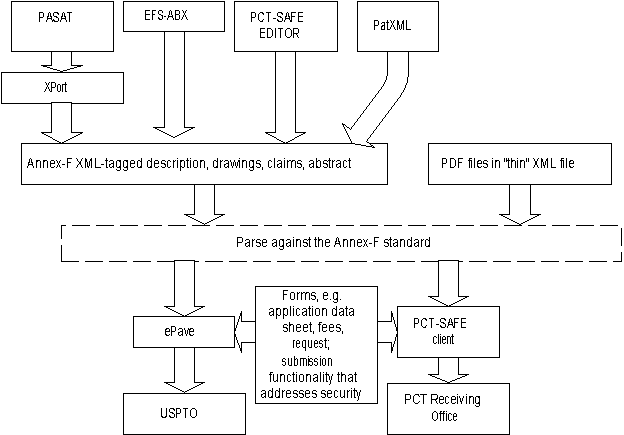
The XML file created by PSE is provided to the PCT-SAFE client, which assembles a submission package and transmits it to a PCT Receiving Office (RO). The PCT-SAFE client is closely modeled on the well-known PCT-EASY system. This means that anyone who wants to get a head start on learning to use PCT-SAFE may do so by using and becoming familiar with PCT-EASY.
During the pilot program the only RO that will receive e-filings by means of PCT-SAFE is the IB (International Bureau). When the system is made available generally, other Receiving Offices will also receive e-filings by means of PCT-SAFE.
PDF submissions. Another authoring possibility under Annex F and PCT-SAFE is to prepare the application body as a set of PDF files (claims, abstract, figures, and description). Under Annex F, it is up to each Receiving Office to decide whether it will receive an application body in PDF format. When you launch the PCT-SAFE client it asks which Receiving Office you wish to use. If the Receiving Office you choose is one which has said it is willing to receive PDF submissions, then the PCT-SAFE client will permit creating the submission using PDF files. For example, RO/IB, RO/EP & RO/FR have said that they will accept PDF format application bodies.
The PCT filing fees effective January 1, 2004 will provide incentives for filers to e-file. As compared with the filing fee for a paper filing, the following discounts will be available:
It is clear from this that whileWIPO wishes to encourage e-filing generally (including e-filing with PDFs), WIPO wishes filers to appreciate that it hopes filers will learn to submit XML patent specifications.
Cross-platform compatibility. It should be appreciated that XPort, EFS-ABX, and PSE each are designed to create XML files compliant with the Annex-F DTD. As such, it should eventually be possible to author a patent specification using any of the editors mentioned above, and to file that specification using either of the submission engines (ePave or PCT-SAFE FM). This would, for example, permit a filer to prepare an application using PSE and file it using ePave, or to prepare an application using PASAT/XPort and file it using the PCT-SAFE client.