USPTO September 28, 2004 Electronic Filing Forum
This is a report on the events of the USPTO Patent Electronic Filing Forum which took place on September 28, 2004. I have copied from the written agenda and have inserted my own comments based upon my recollections. I have included some of the slides which were shown that day.
The Forum had been in planning stages since at least July 2004. The USPTO mailed invitations about a month ago, leading to a final guest list of 42. The USPTO had a chief goal of bringing in representatives of corporations that file lots of patent applications and law firms that file lots of patent applications. IPO, ABA, and AIPLA were all asked to send representatives as well. In addition a few other patent attorneys from smaller firms were invited.
Corporations represented included 3M, AT&T, GE, Eli Lilly, Ford, IBM, Intel, Microsoft, Motorola and Xerox. Some twenty-three patent firms were represented, including many extremely well-known patent firms. The two traditional top US filing patent firms, Oblon and Sughrue, were among them. The roster listed Larry Hume and Dana Colarulli as representing IPO, Wendi Weinstein as representing ABA, and Bradley deSandro (chair of AIPLA's Electronic Business, Automation and Harmonization of Standards committee) and Carl Oppedahl (vice-chair of that committee) as representing AIPLA.
The majority of attendees were patent attorneys from their respective organizations. About three attendees were network administrators, and about three were clerical staff with responsibility for e-filing at their respective organizations. Among the attorneys in attendance, I sensed some distribution along a spectrum having at one end a very hands-on personal experience with e-filing and at the other end a more limited level of experience with e-filing.
We were given name tags. Each name tag had a colored stripe on it. One color indicated "corporate", another color indicated "law firm", and a third color meant "association".
12:00 - 12:10 Welcome and Introduction (Nick Godici, Commissioner for Patents)
Mr. Godici started by introducing a recorded video address from Director John Dudas. (Director Dudas was apparently in Europe at the time and had recorded this videotaped address earlier.) Director Dudas noted that while e-filing of trademark and patent applications had been available for some years, trademark e-filing was at about 70% while patent e-filing was still only 1-2%. It is thus a very high priority of the Patent Office, the Director explained, to make plans to get the patent e-filing rate up to a comparable percentage. We were all thanked for attending and it was emphasized that our participation was very important to the USPTO to help it figure out whether its present plans for the future were likely to bring about the desired levels of e-filing.
12:10 - 12:20 Forum Overview and Link between EFS and IFW (Edward "Kaz" Kazenske, Deputy Commissioner for Patent Resources and Planning)
Mr. Kazenske explained, among other things, how the present EFS system offers automatic (no USPTO employee manual steps needed) loading of bibliographic information into Palm and of the patent application into IFW.
12:20 - 12:40 Patent E-Filing Potential Strategy: Toward the Future of the Patent Electronic Filing System (Fred Schmidt, Administrator, Search and Information Resources Administration)
Mr. Schmidt explained, among other things, how USPTO hopes that EFS would eventually lead to easier searching by Examiners and cost savings within the USPTO.
12:50 - 2:05 Focus Session 1 - E-Filing Experiences, including Barriers/Constraints to E-Filing (Stratagem Marketing)
The attendees were divided into two groups of about 21 persons each. Each group was sent to a room for a session with a facilitator. Mr. Oppedahl was group A and Mr. deSandro was in group B. Also in each room were a scribe (operating a tape recorder and taking notes) and a couple of USPTO people. The purpose of the colored stripes was to help the scribe attribute each remark to one of the three groupings (corporate, patent firm, association).
The session proceeded much like traditional consumer-product focus groups. A facilitator asked generally non-leading questions directed toward the research goal. (In some focus groups the organizer intentionally does not tell the respondents what the goal is, but in this case the goal was openly stated, namely why people do not e-file.) In some cases the facilitator had followup questions for particular respondents.
We were then each asked to write down reasons why we don't e-file, and to rank them. (It crosses my mind that preceding open-ended questions may in part have been designed to get us thinking so that our written-down reasons would be more complete.)
In this and all subsequent written responses we were asked to mark down whether we were responding for a law firm or for a corporation. Presumably later when the responses are tabulated they will be grouped this way.
The facilitator then passed out copies of a first response form, listing six or so factors that might or might not get in the way of e-filing. We were each asked again to note "corporate" or "law firm" and were asked to rank the factors. These were collected. He read each factor out loud and we were asked by show of hands to respond if we had ranked such a factor highly. He asked a few followup questions. This was repeated with a second response form.
I do not recall the exact wording, but we have been assured that the results of the day's work will be made available to us, the participants. Presumably that will include the text of the response forms as well as the responses.
Factors that respondents mentioned included:
2:15 - 2:45 Electronic Filing System: Present State and Future Possibilities (Terri Raines, Project Manager, EFS)
Ms. Raines presented slides offering a strategic plan for EFS. She emphasized that this plan is merely proposed and that any and all comments from participants might make a big difference in the strategic plan going forward.
The forum attendees were shown slides showing
potential strategies and plans toward this end. Ms. Raines emphasized
that these were potential and not necessarily set into place. One slide
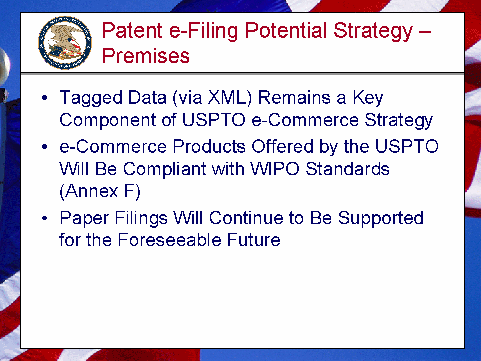
included the following points:
Point A deserves comment. Users of PCT-SAFE have already noticed that WIPO, while having chosen to permit non-XML e-filing (that is, by means of PDF files for the application-body), nonetheless is signaling clearly that it hopes PDF will be a temporary approach with users gradually weaned away from PDF and to fully XML filings. Users of USPTO's IFW system will also have noticed that (doubtless at substantial expense) the USPTO has adopted EPO's Phoenix software to manage images (not text) for pending US patent applications. Users might wonder whether USPTO is committed to XML for patents or whether it has dropped XML in favor of simply using images instead.
I have spoken with many filers in recent years who are a bit puzzled at the notion of PDF patent filings and who feel that XML-tagged text is the right way for the future. I feel that way myself. As you will see in the comments that follow, USPTO seems to intend to stick with XML at least for bibliographic data and may well have a medium-term goal of migrating eventually from image-based workflow to XML-based text workflow.
Point B also deserves comment. USPTO, WIPO, EPO, and JPO have spent many man-years working out the large and fine points of Annex F, which was and is intended to permit authoring a patent application once and then filing it in many patent offices, ideally without the need for format changes. Prior to August 22, 2004, it was possible to author an Annex-F-compliant patent application using any of several authoring tools, and to file it in the USPTO through ePave. Some US patent filers, for example, were routinely authoring in WIPO's PCT-SAFE Editor and filing in the US via ePave. (You can see a page at http://www.patents.com/efs/crossplatform/ describing the progess, prior to August 22, 2004, of cross-platform e-filing efforts.)
Then on August 22, 2004 USPTO changed its ePave server in a way that made it impossible at first, and later merely extremely difficult, to e-file an annex-F-compliant US patent application. The server was changed on that day to refuse to accept a filing package if it had not been e-signed by ABX 1.1, USPTO's authoring package. Since then, filers have learned how to do the e-signing that ABX 1.1 would do, and so there are filers who are now once again e-filing applications in the USPTO via ePave that were authored using non-USPTO authoring tools. This sort of filing is not, of course, formally supported by USPTO.
Point B suggests that USPTO plans eventually to restore things to the way they were before August 22, 2004, namely to again formally accept annex-F-compliant patent application filing packages.
Returning to the slides presented during the September 28, 2004 forum. A
slide described a "Phase I" of a potential strategy taking place in Fiscal Year
2004-2005.
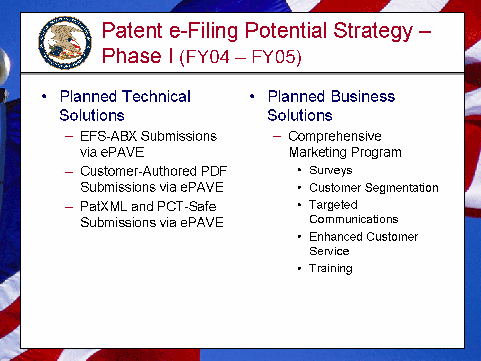 (USPTO's fiscal year begins on October 1, so this would mean
October 2003 to October 2005.) In this potential Phase I, USPTO would release
solutions for the following:
(USPTO's fiscal year begins on October 1, so this would mean
October 2003 to October 2005.) In this potential Phase I, USPTO would release
solutions for the following:
Point D would have the USPTO following in the footsteps of WIPO. The PCT-SAFE software which WIPO beta-tested in Fall of 2003 and released on January 1, 2004 permits e-filing PDF PCT applications in certain receiving offices as of January 2004. RO/US (the USPTO PCT receiving office) does not accept PCT e-filing but RO/IB (the International Bureau of WIPO in Geneva) does accept PCT e-filing. Formerly our firm filed nearly all of our PCT applications in the RO/US on paper. Now that e-filing is available for PCT, our firm now routinely e-files any and all PCT applications in RO/IB that we are able to file there.
You might wonder if Point D means USPTO's e-filing plans relate to PCT or US domestic filings (e.g. utility applications) or both. I have had informal communications with USPTO people that suggest the latter and not necessarily the former.
Point E is interesting. If point E were carried out, this would basically mean removing from ePave the code that was added on August 22, 2004 that was meant to block the use of Annex F and non-USPTO authoring tools.
Returning to the slides presented during the September 28, 2004 forum. A
slide described a "Phase II" of a potential strategy taking place in Fiscal
Year 2005-2006.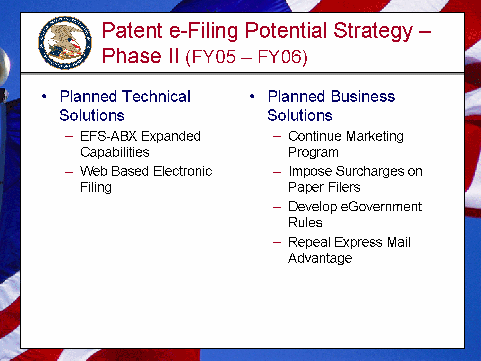 (This would mean October 2004 to October
2006.) In this potential Phase II, USPTO would do the following:
(This would mean October 2004 to October
2006.) In this potential Phase II, USPTO would do the following:
Turning first to point F. Point F draws upon what some people call a "thin client" model. The idea here is to make a filing approach in which the only software the user needs is an operating system and a web browser. Another way to say this is that the filer would use a web browser instead of ePave.
This offers some interesting advantages. For one thing, this would let Mac and Linux users e-file. It would not be tied to Microsoft Windows.
The US Trademark Office has been doing web-based e-filing for years now, through its e-Teas system. e-Teas has come to be so widely used and well accepted that trademark e-filings are, as mentioned earlier, up to 70%.
My personal reaction is that for me, at least, moving from ePave to a thin-client web-based e-filing system would not make a big difference. Our firm is quite comfortable with ePave. We use it not only for US patent filing, but also for e-filing Information Disclosure Statements and assignments. Our firm is also quite comfortable with PCT-SAVE FM, which is WIPO's thick-client e-filing engine. For us, a well-designed thick client is just fine and is not better or worse than a thin-client web-based system.
Of course if our firm routinely used Linux or Mac operating systems, we would sing a different tune and would be very much pushing to get rid of the Windows-dependent thick clients and to migrate to web-based thin clients.
At the forum, lots of users said they would prefer thin-client web-based e-filing systems.
Point G is an interesting one. Here, too, USPTO would be following in WIPO's footsteps. For several years now, WIPO has had a filing discount for those who provide their bibliographic data on diskette. In that system, called PCT-EASY, a filer would get a discount of over a hundred dollars for saving the patent office from having to hand-type the bibliographic data into the PCT systems. Basically the filer was providing on diskette nearly all the information that would be on the front page of the PCT publication. From years ago and to this day, if you file a PCT application in the RO/US you can provide the diskette (along with a paper-filed patent specification) and you can get a filing fee discount, now 100 Swiss Francs.
Then in January 2004, WIPO released three levels of filing-fee discounts, depending on how much work you save for the PCT patent office. As compared with a pure paper filing, you get 100 Swiss Francs off if you provide the diskette with paper. You get another 100 Swiss Francs off if you provide PDF files instead of paper. You get yet another 100 Swiss Francs off if you provide XML files instead of PDF files.
So with Point G we see the USPTO planning to establish a filing-fee differential depending on whether one paper-files or e-files.
As a matter of presentation I would have preferred to see USPTO call it an e-filing discount rather than a paper-filing surcharge.
Point H is an interesting one. Here, the US Patent Office would be following in the footsteps of the US Trademark Office, which over a year ago eliminated Express Mail as a way of getting a same-day trademark filing date. For over a year now, if a trademark filer wants a same-day filing date, they can no longer get it by taking the trademark application to the post office. Instead they must either e-file or file in person by hand carrying the trademark application to the USPTO.
Of course there are some patent filers whose offices are geographically nearby to the USPTO in Alexandria. Those filers, many of whom already hand-carry all of their patent applications to the Patent Office, would be unaffected by point H. They would simply continue hand-carrying their patent applications to the Patent Office. (Such filers would, however, be affected by point G.)
My sense is that points G and H ought to be implemented only after some six-month period during which (overstating things slightly) nobody finds it necessary to call the EBC and nobody finds it necessary to ask for help in this EFS list. Implementing points G and H at a time when users are still struggling with the USPTO's e-filing software would likely lead to unfavorable reactions among filers, it seems to me.
Returning to the slides. A slide described a potential Phase III,
starting in October 2006.
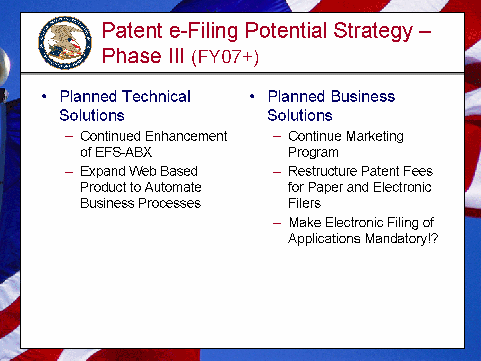 During this potential Phase III, USPTO would:
I take point I to be a variant or extension of point G, perhaps making for a bigger spread between the filing fees for paper and e-filed cases.
Point J is interesting. If carried out, it would instantly bring the e-filing percentage to 100%.
At the forum, it was emphasized that the steps described were "potential" and not set into place. I expect part of this is meant as a sort of study to try to assess whether and to what extent filers would shift over to e-filing if some or all of these steps were carried out. I expect part of this is also meant as a sort of trial balloon to see whether and to what extent filers would negatively if some or all of these steps were carried out.
3:00 - 4:15 Focus Session 2 - Incentives for E-Filing, including Software Features and Non-Software Benefits (Stratagem Marketing)
The respondents were again broken up into the same two groups, each dispatched to a conference room. A chief purpose of this session was to elicit responses to Ms. Raines' presentation.
Open-ended questions included such things as what sorts of incentives, if any, would prompt filers to e-file. Responses included:
We were again asked to write down things, in this case factors that would prompt us to e-file, and to rank them. (We were again asked to label our responses "firm" or "corporation".) These were collected.
As in the first focus session, the facilitator then passed out copies of a first response form, listing six or so incentives that might or might not bring about e-filing. These were collected. He read each factor out loud and we were asked by show of hands to respond if we had ranked such a factor highly. He asked a few followup questions. This was repeated with a second response form.
Again I expect we will eventually get to see the text of the response forms as well as the aggregated responses.
A clear predominant theme among the respondents was to permit PDF filing and to do whatever is needed to eliminate firewall problems.
Some of the questions toward the end were, I suspect, among the most important questions from USPTO's point of view. How would it affect us if Express Mail were done away with? (US trademark filings are already this way; if you want a same-day filing date Express Mail won't work and you must e-file or hand-carry it to the Patent Office.) How would it affect us if paper filing were eliminated as an option for patent filing?
In group A, many commenters said that such changes would be a very big problem unless the software were made truly foolproof and all firewall issues eliminated.
Yet another question was, if USPTO were to contact corporations or law firms to try to "sell" e-filing, whom would USPTO contact. For most corporations the response was either the chief patent counsel or the general counsel. In each case the contact person would be a lawyer rather than a nonlawyer. For most patent firms the response was to contact individual patent attorneys within the firm; in a few cases the response was that a management committee would be the decisionmaker.
4:15 - 4:30 Closing (Edward "Kaz" Kazenske)
We were again thanked for taking the time to attend and to participate. Mr. Kazenske's remarks emphasized that he expects the USPTO to have, within a few years, an "EFW" system rather than an "IFW" system. The terminology is that IFW means "image file wrapper" where the file is image-based. In contast EFW means "electronic file wrapper", namely that what is stored is characters instead of images. This seems to suggest that USPTO remains committed to XML filing and only thinks of PDF filing as an interim approach until most filings are XML-filed.